Yesterday, buried in book editing while on the road, I acknowledged what I’ve been avoiding: I need to absorb and document Australia’s current nuclear debate. You might view this statement as trivial and unprofessional, and, truth be told, I’m ashamed to admit it.
Here’s the essence. The leader of the conservative opposition party here has challenged the governing Labor Party’s climate change policy of shifting to renewables. Peter Dutton has identified seven sites around the country for future nuclear reactors, whilst also (of course) threatening to abandoning the nation’s emissions targets. Hitherto I’ve dismissed Dutton’s verbiage as climate-washing “nonsense” (don’t get me started on how unlikely a pivot to Australian nuclear energy is) and have been inclined to skim news reports, but that was a mistake.
Why does this matter for me? Well, Australia is the only continent without a proper-sized nuclear electricity plant. The Australian government flirted twice with nuclear power, once in the 50s when it entertained the notion of obtaining atomic bombs, and also in the 70s, but the notion made no economic sense and local opposition was overwhelmingly contra. In a book crammed with power reactors and their histories, my treatment of Australia’s nuclear power history was bound to be cursory, restricted to the 50s and 70s. Recent froth about the subject, raised by pro-nuclear fans and Dutton’s greenwashing predecessors, should sensible occupy a single paragraph in my book.
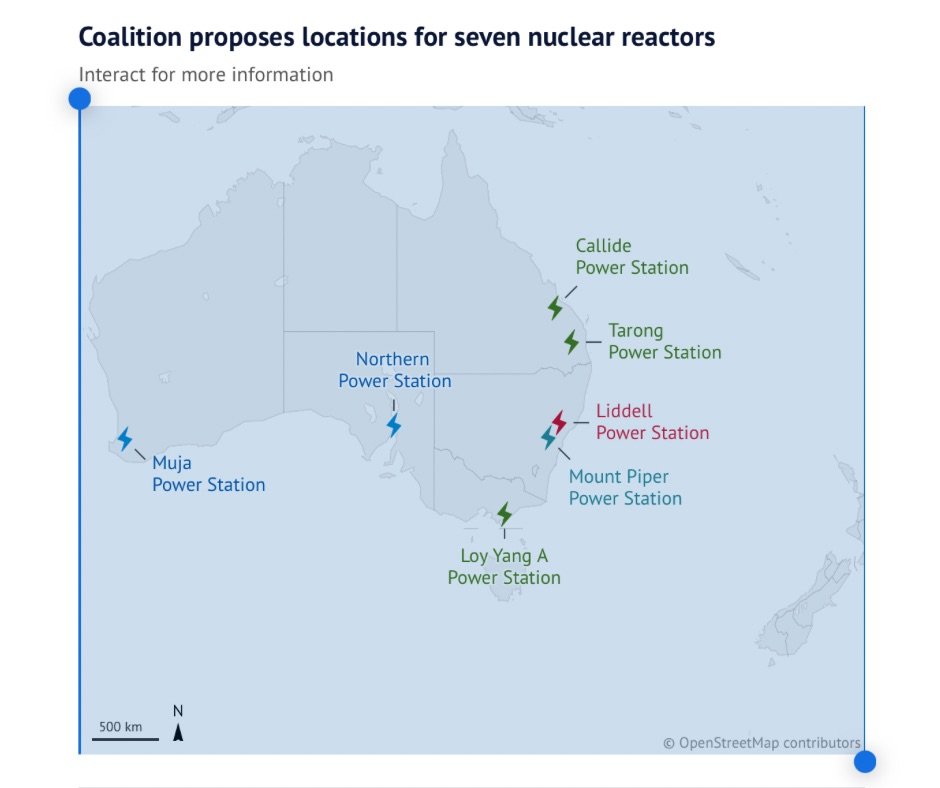
But now, with the topic escalated into a genuine election issue, I’ll have to devote more time and space onto “Dutton-versus-Albanese on reactors.” I need to spend time, time I don’t have, chronicling how the debate fares, both in policy circles and with the wider electorate. I sigh. (Of course, truth be told, I’m also fascinated and look forward to casting my beady eye over the entire proceedings.)