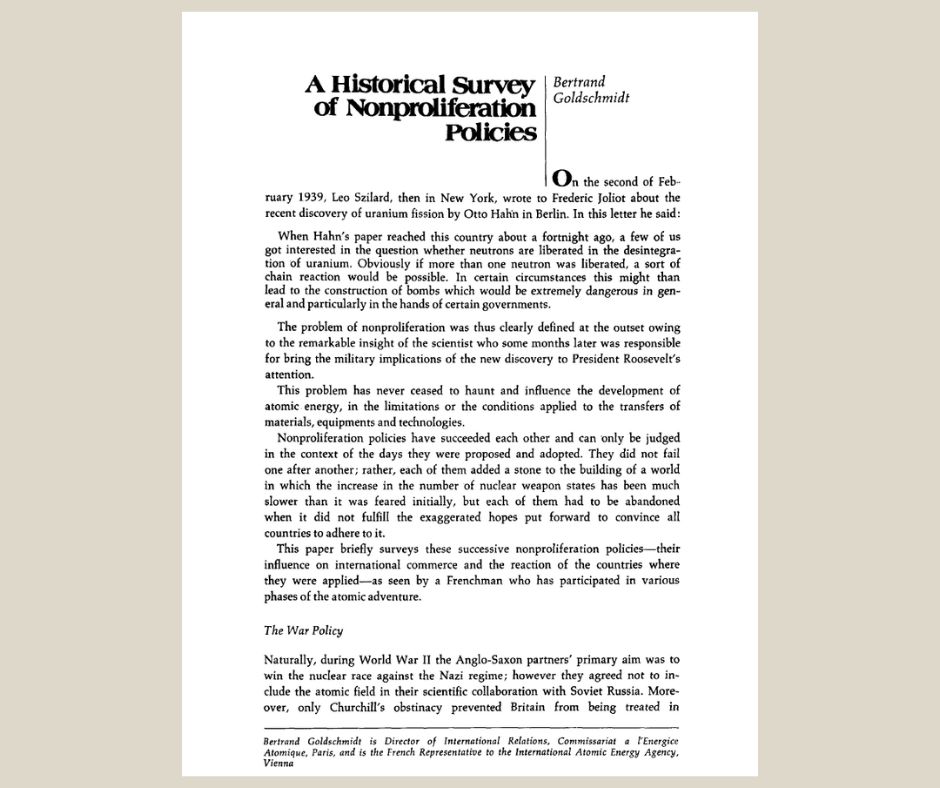
French nuclear chemist Bertrand Goldschmidt never got over his bitterness at France’s rejection by the major Western powers after World War II, the nation having to start almost completely afresh as it clawed its way to nuclear energy and, in 1960, nuclear weapons. The term proliferation didn’t really gain currency until the early 1960s, yet here he is, in 1977, scathingly referring to postwar American/British atomic secrecy as nonproliferation:
In November 1945, three months after the tragic revelation of the power of the new weapon, the three Anglo-Saxon allies officially adopted a comprehensive nonproliferation policy towards the rest of the world and in particular towards the Soviet Union.
Goldschmidt, Bertrand. 1977. “A historical survey of nonproliferation policies.” International Security 2: 69-87, p. 70.
They decided not to disclose any detailed information on the practical industrial applications of atomic energy before effective enforceable safeguards against its misuse could be devised, either in the form of international inspection or otherwise. They also agreed to try to exploit or purchase for their own use all uranium resources available in the Western world. Taken together these two agreements resulted in the perfect nonproliferation policy by blocking the transfer to other countries of the two indispensable technical ingredients of any nuclear effort—know-how and uranium. Today, however, these two ingredients are dispersed throughout the world and are easily available. Such a policy, as reflected in American legislation like the McMahon Act, paralyzed international collaboration and commerce in the nuclear field during the ten years following the end of the war.