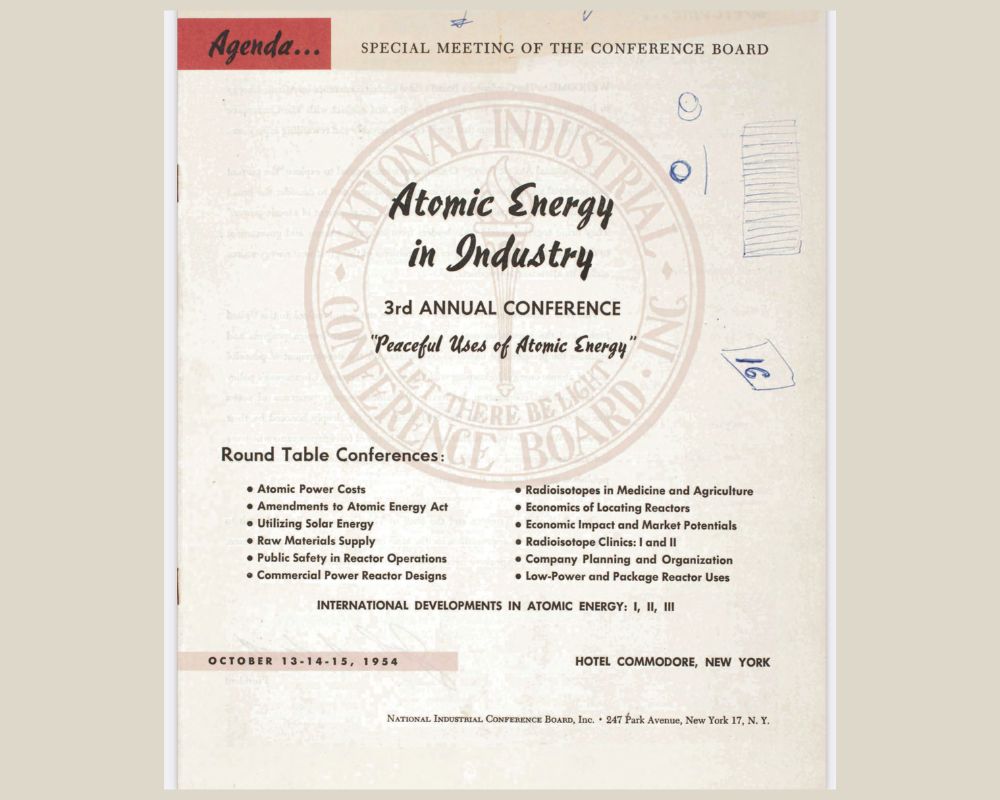
Christopher Hinton, England’s nuclear engineering pioneer, made only a handful of visits to America. His most controversial was in October 1953, when he delivered what he called “a lecture” to a conference (organized by the influential National Industrial Conference Board) in New York titled “Atomic energy developments in Great Britain.” No doubt it struck the U.S. audience as pompous; it certainly strikes me as such as it proclaims the superiority of Britain’s gas-cooled reactor design over America’s water-cooled preference (both these designs were for military reactors manufacturing military plutonium). This speech makes a couple of appearances in my book but I don’t mention a coda, a conference response to Hinton by Henry Dewolf Smyth. 55-year-old Smyth had been a pivotal member of the Manhattan Project and, just after the war, authored an official text titled Atomic Energy for Military Purposes: A General Account of the Development of Methods of Using Atomic Energy for Military Purposes (more commonly, the Smyth Report). By 1953 he was one of the commissioners of the Atomic Energy Commission. In other words, he was a heavyweight. He took exception to Hinton’s words and delivered a muted rebuke:
First of all, let me talk about the Hanford reactor, which he [Hinton] has mentioned specifically as inherently dangerous. He suggests that such a reactor as the one at Hanford “can, under unfavorable circumstances, explode and scatter dangerous fission products over the countryside.”. … I would say “under an improbable combination of unfavorable circumstances” the reactor might explode.
Smyth, Henry De Wolf. 1953. “American view of reactor safety.” Nucleonics, Jan., p. 9.
Sir Christopher suggests two ways of eliminating the dangers from reactors. One is to choose a type that is inherently safe. The other is to place the reactor in the middle of an uninhabited desert. There is a third course that involves two kinds of precautions. One can build into the reactor all kinds of safety controls to minimize the danger of an accident. Sir Christopher seems to be more skeptical than I am of the value of such measures. The other precaution is to design the reactor so that an explosion could take place without dousing the neighborhood with radioactive materials.
One way in which this is done is to enclose the reactor by a strong and gas-tight envelope of some sort. This is what we are doing at the reactor being built near Schenectady. We believe that there are many types of reactors where an explosion can be contained by a less elaborate and expensive structure than this one.
Smyth also needled Hinton by pointing out American safety regulation had by that time advanced to oversight by an independent committee, something the United Kingdom took years to install.
I have so little material about that conference that I don’t know if any of the other reactor pioneers attended, or if anyone else spoke, or indeed if Hinton responded to Smyth. What I do know is that American light-water reactors, swathed in “strong and gas-tight envelopes of some sort,” dominate today’s reactor picture, whereas the British gas-cooled design died out after the 1970s.