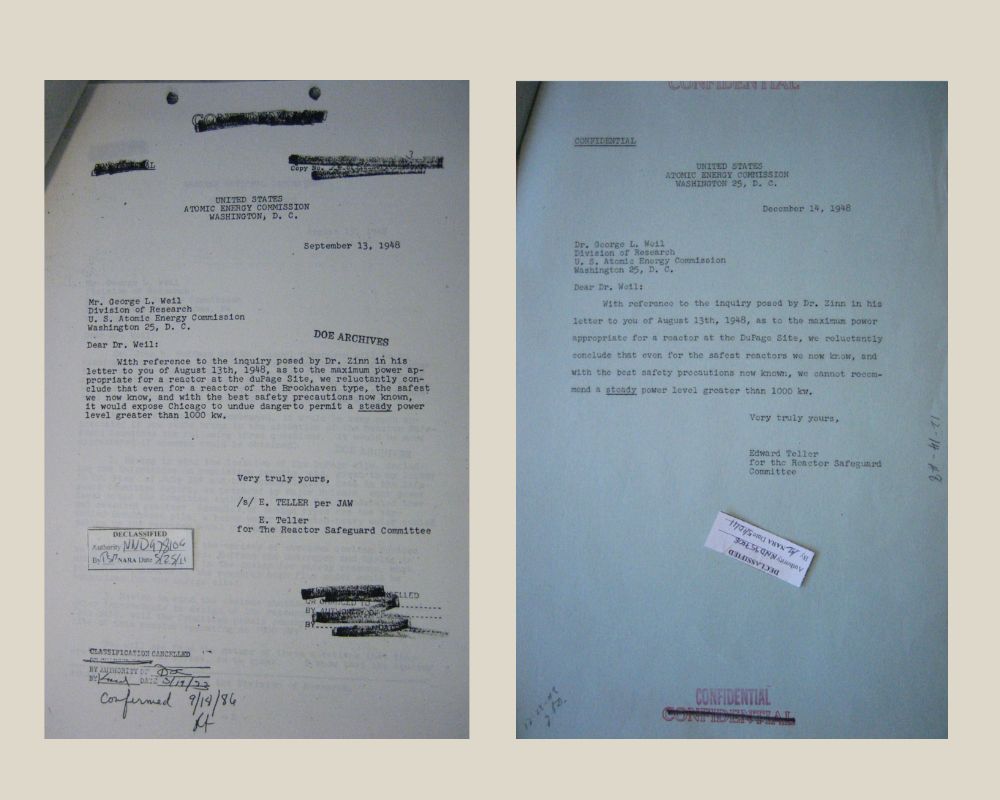
I’m being less than precise with the heading of this post for the post features the 1948 U.S. Reactor Safety Commission editing its own words, and I’m skating over the fact that the RSC had no power, was just an advisory commission (but, in my defense, it had enormous cachet at a time of little expertise). Anyway, my last post featured Argonne’s head, Walter Zinn, petitioning the RSC as to what kind of reactor, and how large a reactor, might be permitted to be built on its the laboratory’s then-in-construction site near Chicago.
Zinn queried on August 13. On September 13, Edward Teller, chairman of the RSC, responded (briefly and completely ignoring Zinn’s August sequence of questions):
With reference to the inquiry posed by Dr. Zinn in his letter to you of August 13, 1948, as to the maximum power appropriate for a reactor at the DuPage Site, we reluctantly conclude that even for a reactor of the Brookhaven type, the safest we now know, and with the best safety precautions now known, it would expose Chicago to undue danger to permit a steady power level greater than 1000 kw.
Teller, Edward. 1948. Teller to Weil, Sep. 13, 1948. “MTR, Vol. #1,” Box 52, Entry E-67A1, RG 326. NARA, College Park, Maryland.
Fair enough, one might say. But three months later, on December 14, AEC withdrew that letter and replaced it with:
With reference to the inquiry posed by Dr. Zinn in his letter to you of August 13, 1948, as to the maximum power appropriate for a reactor at the DuPage Site, we reluctantly conclude that even for the safest reactors we now know, and with the best safety precautions now known, we cannot recommend a steady power level greater than 1000 kw.
Teller, Edward. 1948. Teller to Weil, Dec. 14, 1948. “MTR, Vol. #1,” Box 52, Entry E-67A1, RG 326. NARA, College Park, Maryland.
Note that the only difference is the earlier designation of Brookhaven’s design as being the safest. The second response omits that specific. Although it’s impossible to be certain as to why the change, one distinct possibility is an early caution against calling any one design or model THE SAFEST. Why is that a problem? Because then any other design or model is LESS SAFE, and with nuclear power, anything less than perfect safety is a red flag. Perhaps AEC told Teller, “let’s not impugn any non-Brookhaven designs, okay?” Perhaps.