Fortune smiled upon me the day I discovered I could peruse the diaries of Christopher Hinton, one of the two core drivers of British nuclear energy in the 40s through the 50s. I think I spent a fortnight at the evocatively named address of One Birdcage Walk overlooking the very London vista of St. James Park. The Institution of Mechanical Engineering feels like an ancient order of professionals, quiet and serious. Not all the years of Hinton’s diaries are available to the general researcher and I was refused access (by a Hinton descendant) to a couple of years I would have loved to examine, but what I did find was gold. I took photo after photo, and when I returned to Australia, I went through my treasure day by day, a painstaking, frustrating task.
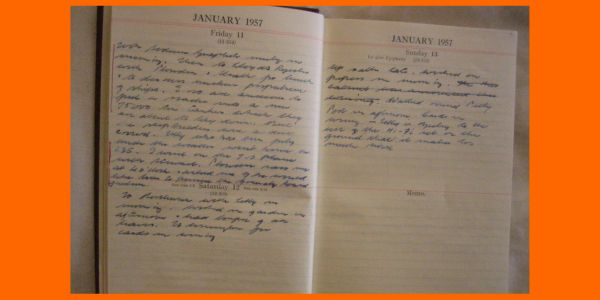
You can see how tough the job was by looking at the image below. Hinton’s handwriting is nigh unreadable, although after a while I did get used to it. Often my transcribed entries contained question marks for words or phrases that eluded deciphering. And let’s be clear, Hinton was very careful to keep anything work-sensitive out of his diaries. Nonetheless, he couldn’t help but let his opinions leak out, as in this entry for January 11, 1957:
Took Sodium Graphite meeting in morning, then to Lloyds Register with Plowden & Strath for lunch & to discuss nuclear propulsion of ships. Esso are anxious to put a reactor onto a new 75000 ton tanker which they are about to lay down. But the shipbuilding men were a dull crowd.
Hinton, Christopher. 1957. Hinton diary 1957. “A.43,” Box “Hinton of Bankside – A.32 – A.45”. Institution of Mechanical Engineers, London. Jan. 11.
I can’t help but think that the “dullness” of the shipbuilding “crowd” was why the United Kingdom never built a nuclear-powered ship.