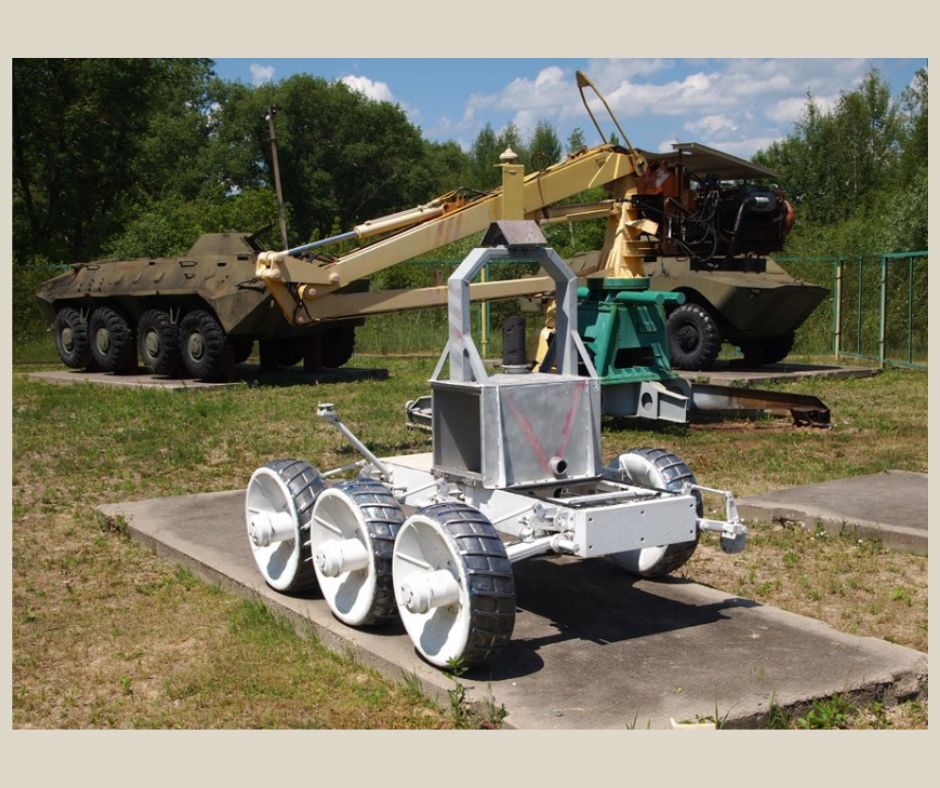
Another weird and wonderful slice of life from Alexander Borovoi, describing his witnessing of the attempt of a Soviet robot to examine the deep, highly radioactive innards of the wreck of Reactor No. 4. (One of the frustrating aspects of this book is the lack of specific details such as, in this case, how big the robot was. The image below is apparently from a Chernobyl robot museum but I have no idea if it’s larger or smaller than the machine being described below.)
In the beginning, a picture of the corridor where the tests were to be held appeared. This place was famous for its high radiation fields, which increased with the approach to the Unit. The robot was already in fighting trim; its operator and the other participants of these tests were behind the buttress. After short preparations, the robot rolled straight ahead on its wheels. It got about twenty feet, ran into an obstacle—a metal tube lying across the corridor—and stopped. I couldn’t say that the tube was very big; its diameter wasn’t more than five inches. In comparison with the robot, the obstacle looked minuscule, but nevertheless, the robot couldn’t overcome the tube.
Borovoi, Alexander A. 2017. My Chernobyl: The Human Story of a Scientist and a Nuclear Power Plant Catastrophe. Piscataqua Press, Portsmouth, New Hampshire, pp. 59-60.
With the camera fixed on the robot, we saw two people in ordinary white jumpsuits and masks—who had obviously left their refuge, even though no one had foreseen that it would be necessary to enter areas of high radiation—run to the robot and carry it, with great difficulty, over the tube.
The robot continued on, but unfortunately, the way wasn’t long again. In five feet it stopped. For some minutes the operator jerked and turned the handles on the operating board, but without any result. The robot moved neither forward nor backward. The camera recorded someone saying, “We shouldn’t have affixed our signatures for this junk. Now we have to get into roentgens again. What did you do this for, Jura?”
Again, two white figures ran to the robot and turned it back. The operator manipulated the board, but the robot stood without moving. At last, the operator waved his hand in despair and stopped trying to bring life to the robot. Two or three minutes passed. And then, absolutely unexpectedly and absurdly waving its antennae and blinking its lamps, the robot turned the other way around, rolled along the corridor, made a grinding noise, and fell onto its back.
“Sound! Switch off the sound!” shouted the manager of these tests. But this shout was too late. Such masterly curses rushed upon the auditorium out of the TV speakers, that everyone involuntarily stood up. In such a ceremonial atmosphere, the demonstration ended.