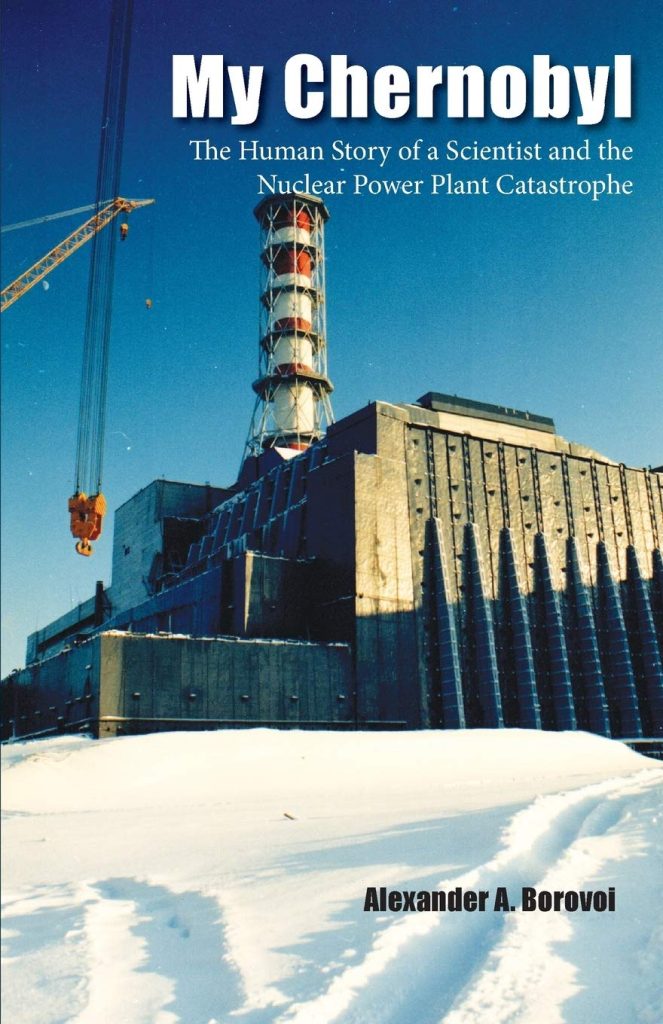
I’ve only recently stumbled across a Russian book written in 1996 but not translated (at least in easily available form) until 2017. A Moscow engineer at the famous Kurchatov Institute, Alexander Borovoi began commuting to Chernobyl soon after the 1986 calamity, part of the huge team struggling to contain the aftermath. My heart leapt when I bought it on Kindle but it turns out much of it is oddly written and not that useful (and some of his reminisces can be found in recent historians’ books). But some snippets fascinate, such as this one:
And now I would like to describe in a few words our everyday Chernobyl life. Our hostel, which was also a laboratory, was in the building of the gynecological department of the Chernobyl municipal hospital. At first sight, this choice seemed strange, but it can be understood if you take into consideration that it was very easy to decontaminate the rooms of the gynecology. The majority of them were tiled, the walls and ceilings were covered with white oil paint, and the tables and other furniture were made of stainless steel. There were two shower rooms and a bathroom. Almost ideal conditions for decontamination.
Borovoi, Alexander A. 2017. My Chernobyl: The Human Story of a Scientist and a Nuclear Power Plant Catastrophe. Piscataqua Press, Portsmouth, New Hampshire.