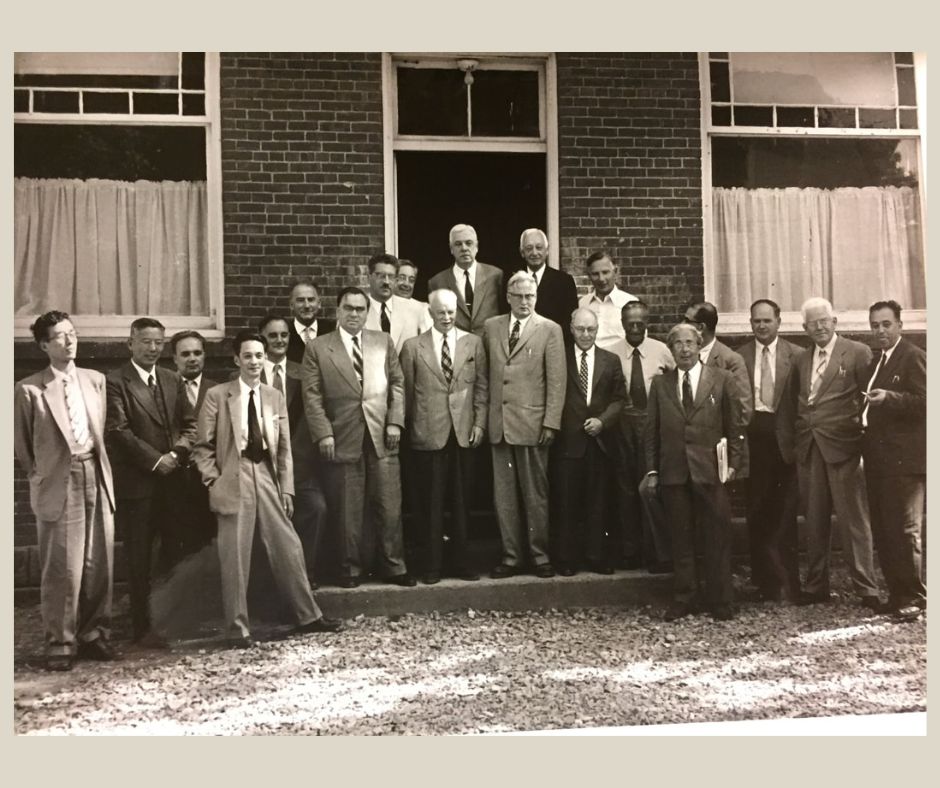
One of the fascinating aspects of writing a nuclear book is that one cannot explore everything. Take, for example, Pugwash, introduced here by historian Toshihiro Higuchi:
Another impetus for transnational activism among scientists for a test ban came from an international conference in July 1957 held in Pugwash, a small village in Nova Scotia. Organized as a follow-up to the famed Russell-Einstein Manifesto issued in 1955, this private meeting of leading scientists from both Cold War blocs was convened to discuss the dangers of nuclear weapons, including global fallout from nuclear tests. … After extensive discussion, the conference unanimously agreed that the linear non-threshold hypothesis was a prudent basis to assess the genetic and cancer effects of low-dose radiation. As was the case for Schweitzer and Pauling, however, Pugwash’s most significant contribution to the politics of risk was an ethical one. The final statement noted that the effects of fallout were “global, and exerted upon citizens of all countries, regardless of whether they or their governments have approved the holding of tests.” In such a situation, it declared, “the usual criteria as to whether a given hazard is justifiable cannot be applied.’
Higuchi, Toshihiro. 2020. Political Fallout: Nuclear Weapons Testing and the Making of a Global Environmental Crisis. Stanford University Press, California, pp. 126-127
Pugwash intrigued me, in a vague way, decades ago, and I kept coming across the organization, although my understanding was shallow. Pugwash continues today with a lower profile than it had back in 1957 and over the ensuing couple of decades. Take a look at the 1957 photo below. It includes two scientists not mentioned in my book (Victor Weisskopf and Joseph Rotblat) and three scientists who do play minor or major roles in my tome, namely Mark Oliphant (an Australian!), Hermann Muller, and (fifth from the right) chubby, charismatic Leo Szilard.