Two of the greatest contributors to nuclear energy, in different eras, were the Italian genius, Enrico Fermi (1901-1954), and the American chemist, Glenn Seaborg (1912-1999). Fermi designed and built the first reactor, Seaborg discovered plutonium and, more pertinently, chaired the U.S. Atomic Energy Commission for a decade from 1961. I enjoyed this 2001 reminisce from Seaborg (in a final memoir cowritten with his son) about his friend Enrico, who had died, too young, nearly half a century earlier:
Although Fermi had made several other contributions that would have qualified him, the Nobel committee recognized him for his work on transuranium elements in December 1938. The timing was not simple happenstance. War was looming in Europe; Mussolini was doing Hitler’s anti-semitic bidding; and Fermi’s wife was Jewish. The quip around the Rad Lab was “Now we’ll see if he deserved the prize – let’s see how smart he really is,” meaning “Would he find a way out of Italy?” He did. He already had a “temporary” seven-month appointment at Columbia University arranged. What a coincidence that a stay of more than six months in the United States required an immigrant rather than a tourist visa; Fermi could bypass the quotas to qualify for an immigrant visa as an academic. He and his family went to Stockholm to collect the prize and then sailed directly for America.
Seaborg, Glenn T., & Eric Seaborg. 2001. Adventures in the Atomic Age: From Watts to Washington. Farrar, Straus and Giroux, New York, p. 57
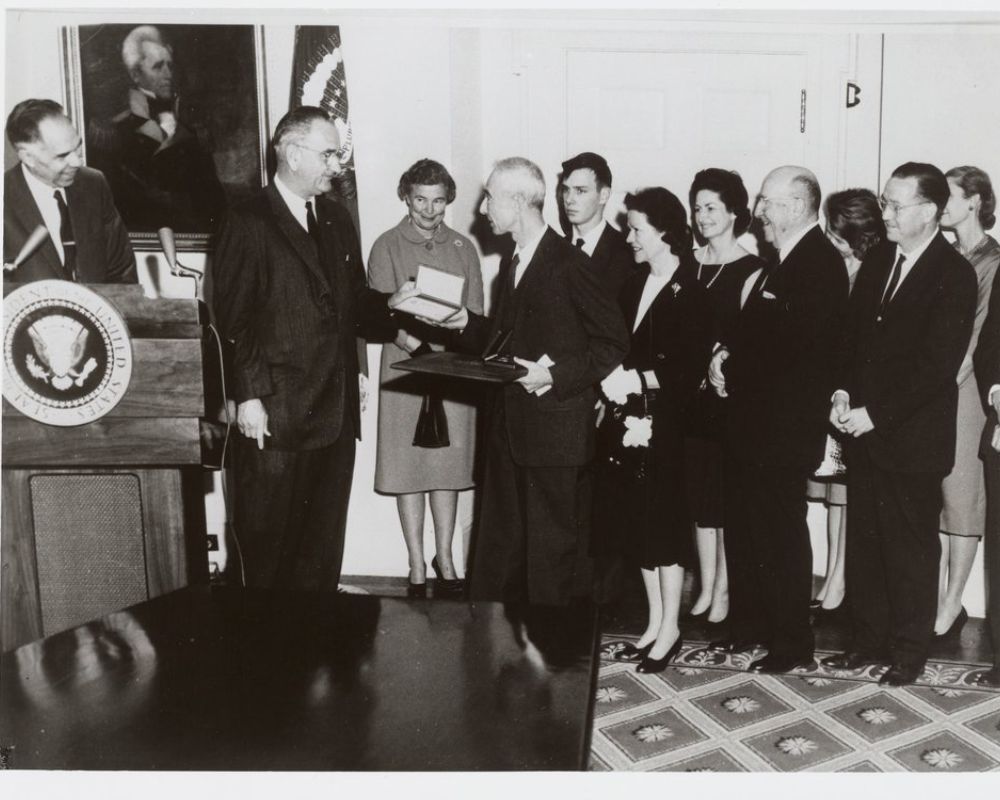
[I don’t have a photo of Fermi and Seaborg together. After Fermi died, a prestigious nuclear award was named after him, and here we see Seaborg (far left) presiding over a Fermi Award presentation to Oppenheimer.]