History humbles. I’m constantly amazed by how little I know about the subject of my book, nuclear power. In taking notes about radioactive waste, I came across the following paragraph from a book on the topic by prolific historian Jacob Hamblin:
One of the topics of discussion was the oceanographers’ idea to create a new laboratory under the auspices of the IAEA. This laboratory would study the relationship between radioactivity and the sea. Its existence would imply long-range financial support, which was why oceanographers wanted it and atomic energy establishments loathed the idea. The laboratory had the potential to become a font of criticism by oceanographers perpetually casting doubt on waste disposal in order to receive funding. By sharing instruction briefs, the Americans discovered that the British bristled at the thought of more mushrooming scientific projects, but for political reasons they did not want to be seen as the only nation to oppose the new laboratory. Cockcroft’s instructions were to “do what he can to curb [IAEA’s] natural proclivities in this matter” without blatantly taking too strong a stand against international scientific studies. One official urged the British delegation to show a “conspicuous lack of enthusiasm” but admitted that it had become politically impossible not to support such studies. The oceanographers had become too powerful.
Hamblin, Jacob D. 2008. Poison in the Well: Radioactive Waste in the Oceans at the Dawn of the Nuclear Age. Rutgers University Press, New Brunswick, New Jersey, p. 181.
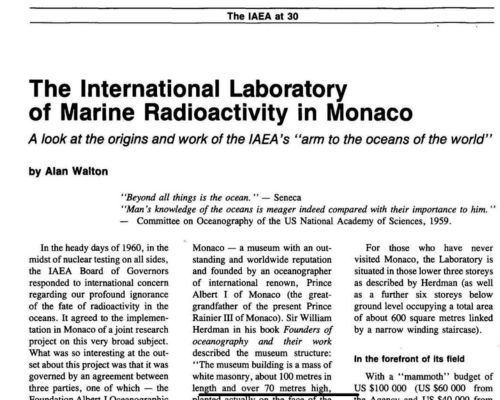
Really? A watery radwaste lab in the town of gambling and luxury holidays? Surely, given what Hamblin says about opposition to the very notion of such a laboratory, it never came to be? But it did. A moment’s Googling reveals plenty of material (such as the review piece below) about what is now IAEA’s Marine Environmental Studies Laboratory. The laboratory never seems to crop up in news or historical analysis, and is peripheral to my needs, so my initial thought of “hey, I must now find out everything about this” has been easily quashed, but I’m sure much, much more historical data on nuclear reactors exists that I’m not even aware of.