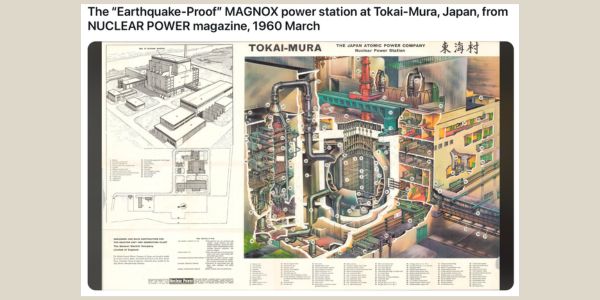
Japan purchased one British power reactor, Tokai 1, a gas-cooled, very British design on the large side (160 MWe) for the times. It began operating in 1966. They never bought British again, heading exclusively to American reactors from then on. What I find interesting about this purchase and the subsequent rejection of that design stream, is not how much I know about it (I have quite enough material to figure out what happened), but how much I don’t know. A frustrating example is this excerpt from the comprehensive but broad-brush 1981 history of the nuclear age written by Peter Pringle and James Spigelman:
In 1957, Britain’s chief nuclear engineer, Sir Christopher Hinton (whom Shoriki brought to Tokyo at his own expense), advised that it was technically possible, but as yet untested even by the British, to increase the size of the first successful gas-cooled reactor. Shoriki promptly ordered the biggest one he could get. He refused to listen to the other members of the Japanese AEC who, counseling caution, wanted some independent domestic research done before buying the British product. Japanese scientists were quick to point out that the pile of graphite bricks surrounding the core might be an acceptable structure in Britain but it was totally unacceptable in earthquake-prone Japan. Those with long memories recalled the last British effort to introduce “progress” into Japanese society. During the Meiji era, British architects and construction engineers, then regarded as the best in the world, had built massive structures like the Army Staff Headquarters and the Foreign Ministry in Tokyo; both had been completely destroyed by earthquakes. A brief but intense debate ensued in Japan over reactor safety, but nothing deterred the ebullient Shoriki.
Pringle, Peter, & James Spigelman. 1981. The Nuclear Barons. Holt, Rinehart & Winston, New York, pp. 173-174.
Among my frustrations with this beguiling extract is that the book’s reference notes contain no source material at all for the statements. I have plenty of archival material about Hinton’s trip to Japan and his subsequent talks with various Japanese visitors, but nothing about his statements about sizing. Nor do I have anything about warnings from Japanese scientists about the dangers of a stacked graphite block in an earthquake zone (something clearly relevant now after Fukushima). Perhaps there is plenty of Japanese-language material stuck in Japanese archives, but I’m not even aware of accessible archives over there. If Pringle and Spigelman had cited, for example, some Japanese-language articles or papers, I could be confident of their statements but since there are no such citations, all I’m left with is uncertainty and an aching guilt that I never went to Japan to hunt for material.