Nuclear reactor licensing is now a mammoth exercise in fulfilling regulations, providing safety information, and negotiating regulator feedback. Back in 1948 there was next to nothing. Walter Zinn was just establishing his new Argonne laboratory at a DuPage site outside Chicago. He had messily wrested control of most nuclear power (as distinct from the predominant focus on bombs) experimentation from Oak Ridge and he was desperate to have a “materials testing reactor,” bigger than his first research reactors (although still very small by modern standards) and able to subject reactor components to large radiation fluxes in anticipation of proper power reactors.
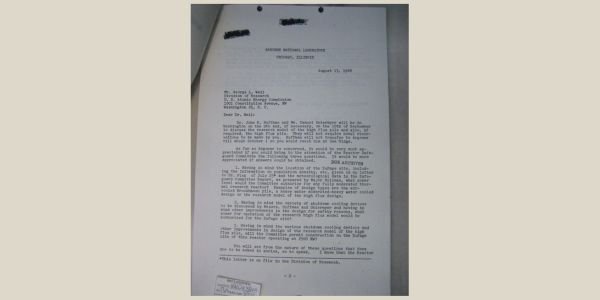
In August 1948, the Reactor Safety Committee, chaired by exuberant Edward Teller, was a year old. Tasked with reviewing new reactor designs before they were approved and funded, the RSC was making Zinn’s life difficult. He sent a couple of his engineers to Washington, and on the 13th, wrote to a friend at AEC: “As far as Argonne is concerned, it would be very much appreciated if you could bring to the attention of the Reactor Safety Committee the following three questions.” Snarkily, he added: “It would be more appreciated if answers could be obtained.” I find his three questions to be in line with his agile, forthright mind:
1. Having in mind [location and meteorogical data] what power level would the Committee authorize for any fully moderated thermal research reactor? Examples of design types are the air-cooled Brookhaven pile, a heavy water moderated-heavy water cooled deign or the research model of the high flux design.
Zinn, Walter H. 1948. Zinn to Weil, Aug. 13, 1948. “MTR, Vol. #1,” Box 52, Entry E-67A1, RG 326. NARA, College Park, Maryland.
2. Having in mind the variety of shutdown cooling devices to be discussed by [Huffman] and [Untermyer] and … [other safety upgrades] … what would be authorized for the DuPage site?
3. Having in mind the various shutdown cooling devices and other improvements in the design of the research model of the high flux pile, will the Committee permit construction on the DuPage site of this reactor operating at 2500 KW?
You will see from the nature of these questions that they are to be asked in series, so to speak. I know that the Reactor Safeguard Committee would much prefer to answer first question No. 3. From the point of view of thinking about a research reactor for our laboratory, it would be most helpful to have an answer to question No. 1. Any way in which answers to these questions can be obtained either separately or collectively would help us very much in getting on with planning our research reactor.”
With the passage of time, it’s hard for me to discern Zinn’s actual point but I guess he was asking the RSC for clarity rather than ambiguous concerns. Three quarters of a century later, life is far more onerous and complex for a reactor designer/manufacturer but the same dynamics surely apply (I’m simplifying, for sure, but you get the point).