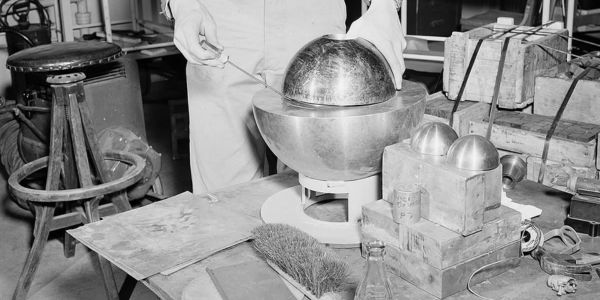
The death from acute radioactivity of Canadian physicist Louis Slotin after an accident at Los Alamos on May 21, 1946 is well known and I don’t include it in my book because it has nothing to do with nuclear power as such (other than being a cautionary tale known by everyone in the nuclear power field). Slotin was a plutonium bomb expert bar none and had helped assembly the first nuke at Trinity in 1945, and on that May day he was “tickling the dragon’s tale,” fiddling around with an exposed plutonium core for research purposes. I don’t want to dwell on the actual accident but it’s worth reading the following pithy account from a masterful 2016 Alex Wellerstein article, “The demon core and the strange death of Louis Slotin“:
Slotin’s procedure was simple. He would lower a half-shell of beryllium, called the tamper, over the core, stopping just before it was snugly seated. The tamper would reflect back the neutrons that were shooting off the plutonium, jump-starting a weak and short-lived nuclear chain reaction, on which the physicists could then gather data. Slotin held the tamper in his left hand. In his right hand, he held a long screwdriver, which he planned to wedge between the two components, keeping them apart. As he began the slow and painstaking process of lowering the tamper, one of his colleagues, Raemer Schreiber, turned away to focus on other work, expecting that the experiment would be uninteresting until several more moments had passed. But suddenly he heard a sound behind him: Slotin’s screwdriver had slipped, and the tamper had dropped fully over the core. When Schreiber turned around, he saw a flash of blue light and felt a wave of heat on his face.
Slotin died nine days later. The connection that I find poignant is that Enrico Fermi, one of the early heroes in my book, chided him after watching him work and play: “Keep doing that experiment that way and you’ll be dead within a year.” (This is from one of physicist Ralph Lapp’s books, Atoms and People (p. 58); I presume Lapp, who had worked on the Manhattan Project, interviewed his mentor Fermi.) Fermi wasn’t adverse to taking risks himself but I often find myself wishing for an alternative universe in which the young daredevil (then aged 35) had listened to the older sage.