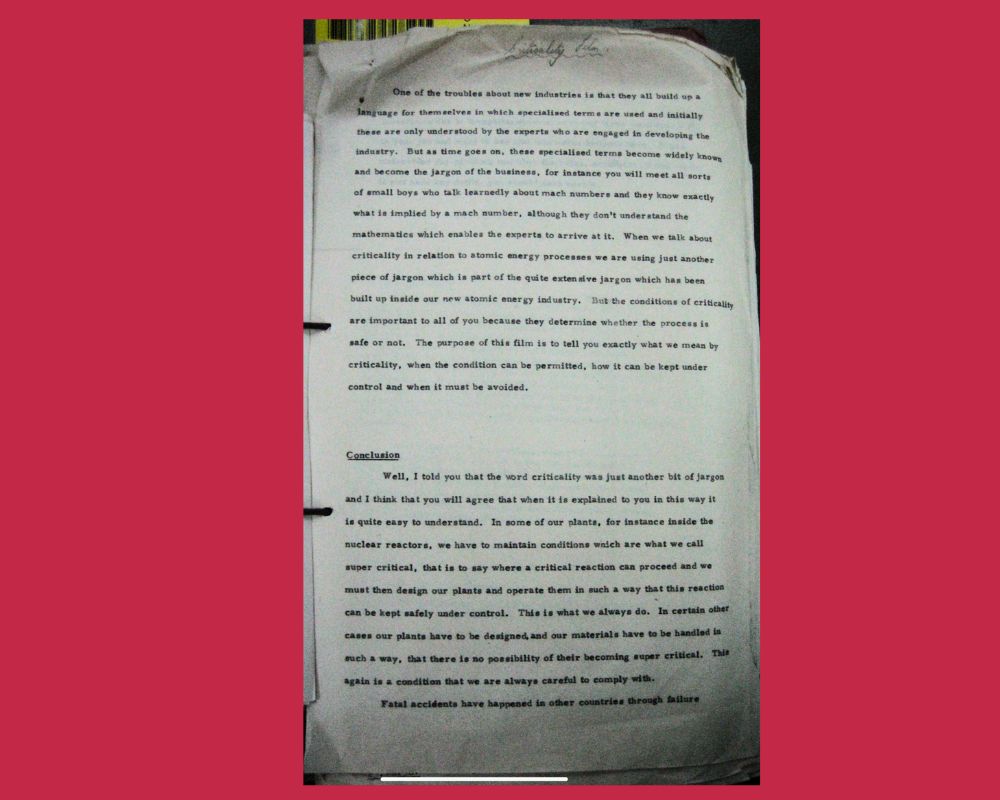
You might have noticed how often Christopher Hinton, the engineer who could be called the “father of British nuclear energy,” recurs in this Nuclear Power History blog. Why? Because he is just so interesting as a human being. A domineering boss, he could also be disarmingly idealistic. In the Kew archives, I stumbled across a couple of pages of a script of a doco he must have made covering the arcane subject of “reactor criticality.” My notes from the archival visit imply that the doco was “a safety film about criticality,” though I’ve never viewed the film nor found anything else about it (that doesn’t mean the archives don’t contain such extra detail, it’s just that my circumvented stay there might have missed more). But what I like is how Hinton’s personality shines out from this first paragraph:
One of the troubles about new industries is that they all build up a language for themselves in which specialised terms are used and initially these are only understood by the experts who are engaged in developing the industry. But as time goes on, these specialised terms become widely known and become the jargon of the industry, for instance you will meet all sorts of small boys who talk learnedly about mach numbers and they know exactly what is implied by a mach number, although they don’t understand the mathematics which enables the experts to arrive at it. When we talk about criticality in relation to atomic energy process we are using just another piece of jargon which is part of the quite extensive jargon which has been built up inside our new atomic energy industry. But the conditions of criticality are important to all of you because they determine whether the process is safe or not. The purpose of this film is to tell you exactly what we mean by criticality, when the condition can be permitted, how it can be kept under control and when it must be avoided.
Hinton, Christopher. 1956. Documentary script fragment. AB 19/21. National Archives, Kew, United Kingdom.