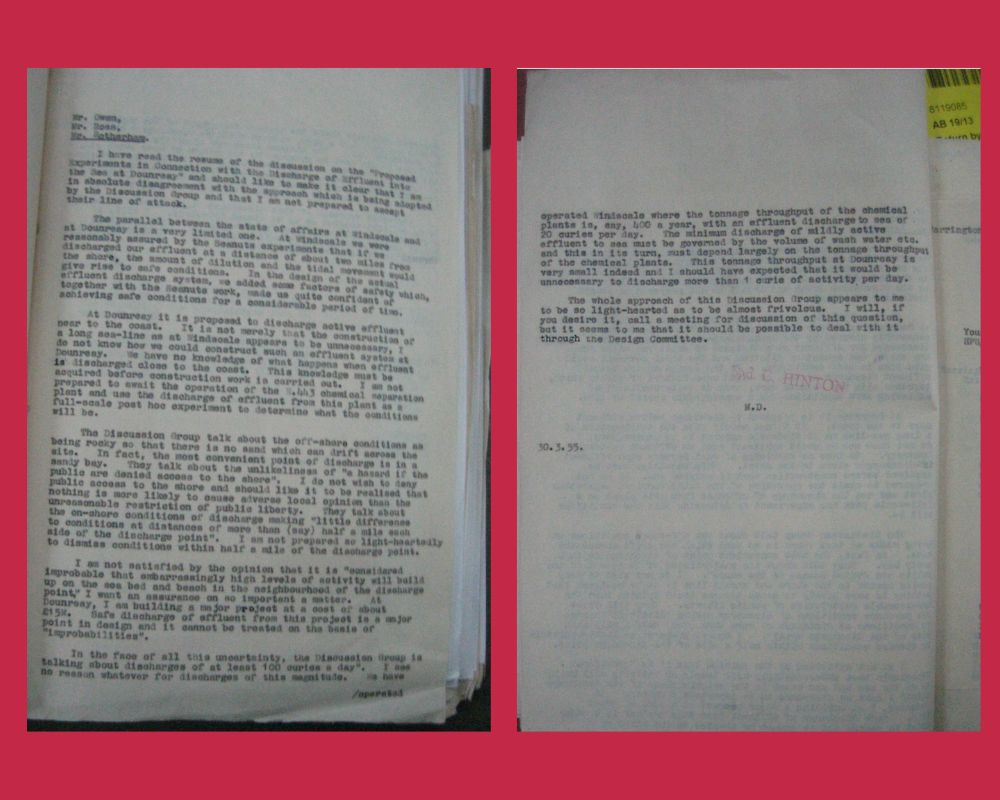
Early British thinking about nuclear waste was dominated by the liquid that came out the other end of plutonium reprocessing plants, firstly at the military reservation at Windscale and then, in the mid-1950s, in remote north Scotland where a pilot breeder reactor was being built with a view to reprocessing non-military waste and recycle it, again leading to liquid end-waste. Engineer Christopher Hinton, always entertaining, is here lambasting a “discussion group” on how such liquid Dounreay waste might be handled. His engineers suggest dumping it into the sea (Dounreay is on the coast). Hinton recoils (I don’t reproduce the technical arguments here):
I have read the resume of the discussion on the “Proposed Experiments in Connection with the Discharge of Effluent into the sea at Dounreay” and should like to make it clear that I am in absolute disagreement with the approach which is being adopted by the Discussion Group and that I am not prepared to accept their line of attack…
Hinton, Christopher. 1955. Hinton to Owen, Mar. 30, 1955. AB 19/13. National Archives, Kew, United Kingdom.
I do not wish to deny public access to the shore and should like it to be realised that nothing is more likely to cause adverse local opinion than the unreasonably restriction of public liberty…
Safe discharge of effluent from this project is a major point of design and it cannot be treated on the basis of “improbabilities.”…
The whole approach of this Discussion Group appears to me to be so light-hearted as to be almost frivolous. I will, if desire it, call a meeting for discussion of this question, but it seems to me that it should be possible to deal with it through the Design Committee.
I’m not wishing to cast Hinton as a hero fighting for ultra-safe radioactive waste disposal. In fact he fights, often deceptively, for years to keep pumping radioactive Windscale waste out along a pipeline into the Irish Sea. Rather, the point of this example is that he recognizes that the topic is a sensitive one, even as early as 1955.