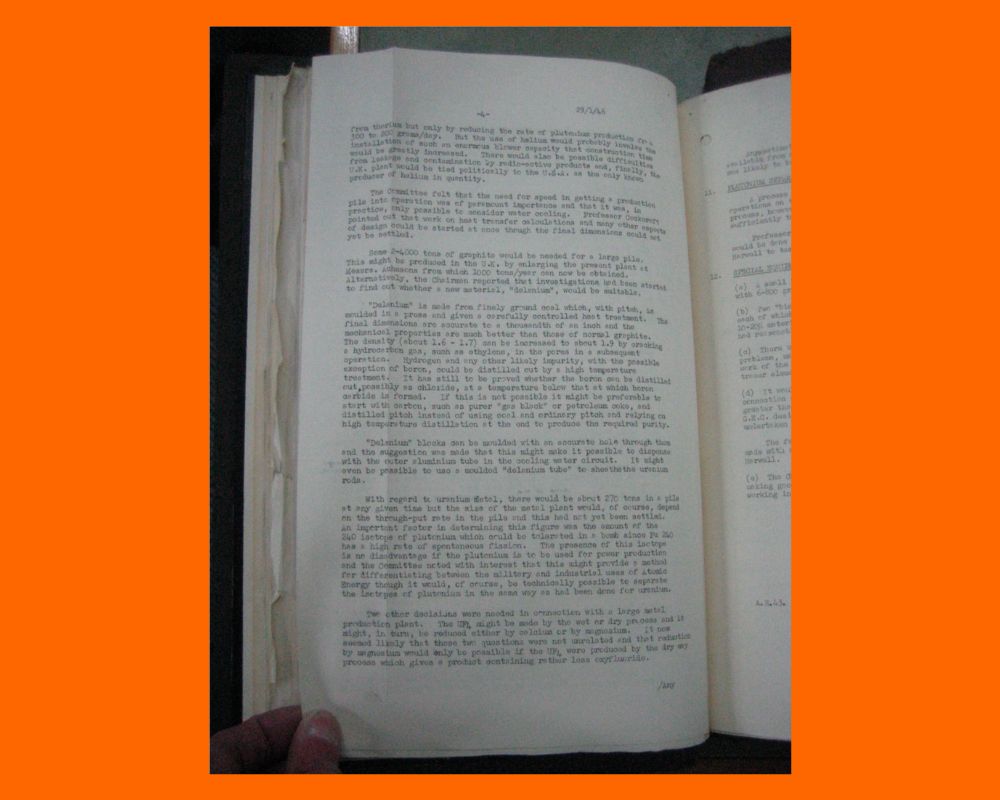
The British World War II atomic effort was named Tube Alloys and it relied heavily on a Technical Committee of just over half a dozen scientists. John Cockcroft was the focus of attention on January 29, 1946, when the 28th meeting of the Technical Committee was held, because Cockcroft was about to kick off his Harwell laboratory and various reactors. Christopher Hinton’s complementary engineering effort at Risley would be launched in a another week. The minutes of Meeting 28 are tedious except for this:
Some 2-4000 tons of graphite would be needed for a large pile. This might be produced in the U.K. by enlarging the present plant at Messrs. Acheson from which 1000 tons/year can now be obtained. Alternatively, the Chairman reported that investigations had been started to find out whether a new material, “delenium,” would be suitable.
Tube Alloys Technical Committee. 1946. Tube Alloys Technical Committee Meeting 28, Jan. 29, 1946 minutes. AB 1/714. National Archives, Kew, United Kingdom.
“Delenium” is made from finely ground coal which, with pitch, is moulded in a press and given a carefully controlled heat treatment. The final dimensions are accurate to a thousandth of an inch and the mechanical properties are much better than those of normal graphite. … It has still to be proved whether the boron [a reactor “poison”] can be distilled out by a high temperature treatment. …
“Delenium” blocks can be moulded with an accurate hole through them and the suggestion was made that this might make it possible to dispense with the outer aluminium tube in the cooling water circuit.
Huh? Delenium? I’ve never heard of it, despite reading so much about so many graphite-moderated reactors. Certainly the UK pioneers were not able to “dispense with” an aluminum tube, so delenium must have been a dud. Indeed, Googling in 2025 yields almost nothing, just something peripheral to coal mining. How fascinating…