W. Bennett Lewis was the British-born third head of the Chalk River nuclear laboratory in Canada. Toward the end of his career, he was shunted sideways, but his influence on matters not only of physics (his specialty) but even engineering was legendary.
The choice of fuel-sheath thickness is another prime example of Lewis’s influence on the project. He was determined to minimize the non-fuel materials within the reactor core that waste neutrons and thereby limit the total heat output from the fuel (neutron economy is discussed in chapter eleven). His goal was a fuel irradiation of 240 MWh/kg, which would result in an attractively low fueling cost for commercial CANDUs. By late 1958, fuel-design details were being specified so that production could begin in 1959. The NPD technical committee reviewed the design. CGE and some of the AECL fuel developers recommended 0.6-mm-thick sheaths, 20 percent thinner than the manufacturers were already making for American reactors. Lewis proposed 0.25 mm and insisted on a sheath no thicker than 0.4 mm for the 19-element fuel, unless it could be proved why it had to be thicker. And he was determined that the performance of thin-sheathed fuel would be demonstrated in NPD from its initial startup. Since all agreed that the seven-element fuel for the outer channels should have 0.6 mm sheaths, this fuel was produced first, giving fuel developers and fabricators a year to investigate thin sheathing. By the beginning of 1960 it was clear that thin sheathing showed considerable promise, but irradiation experience was limited. Consequently, the decision was taken to produce two batches of 19-element fuel, one with 0.6 mm sheaths and the other with 0.4 mm. About 200 bundles of each formed the initial fuel loading for the central channels of NPD in early 1962. The thin sheaths performed well and, ever since, all CANDU fuel has been sheathed with 0.4-mm-thick Zircaloy tubing.
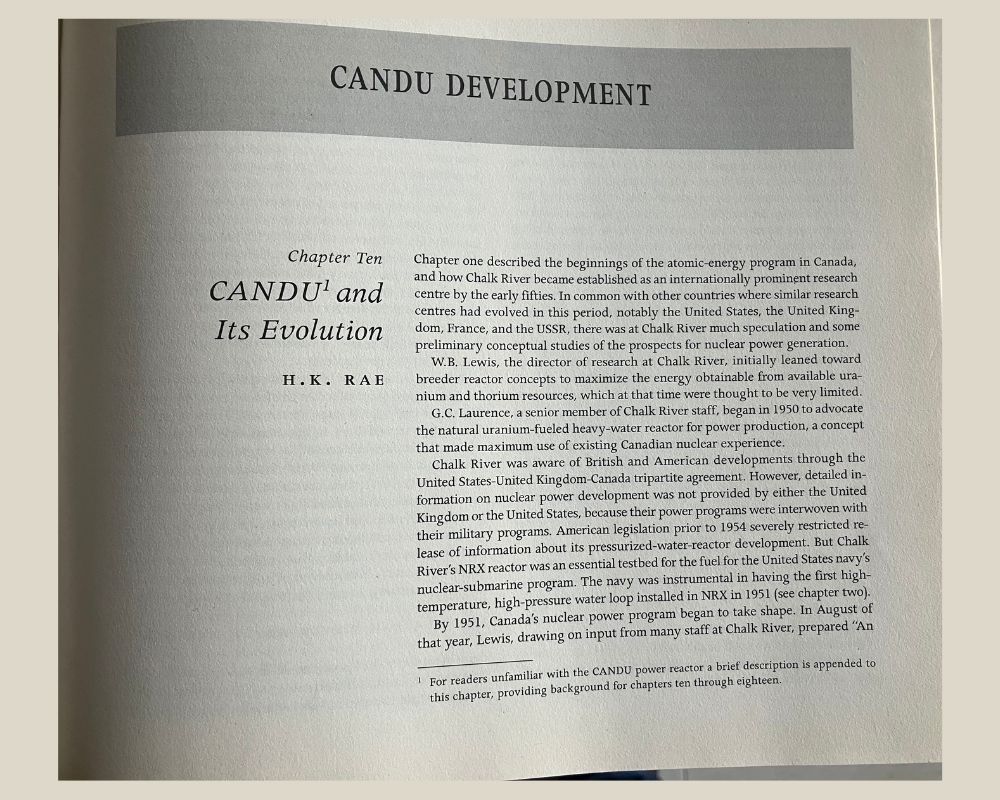
Rae, H. K. 1997. “CANDU and its evolution.” In Canada Enters the Nuclear Age: A Technical History of Atomic Energy of Canada Limited, edited by AECL, 191-214. McGill-Queen’s University Press, Montreal, Canada, pp. 195-196.