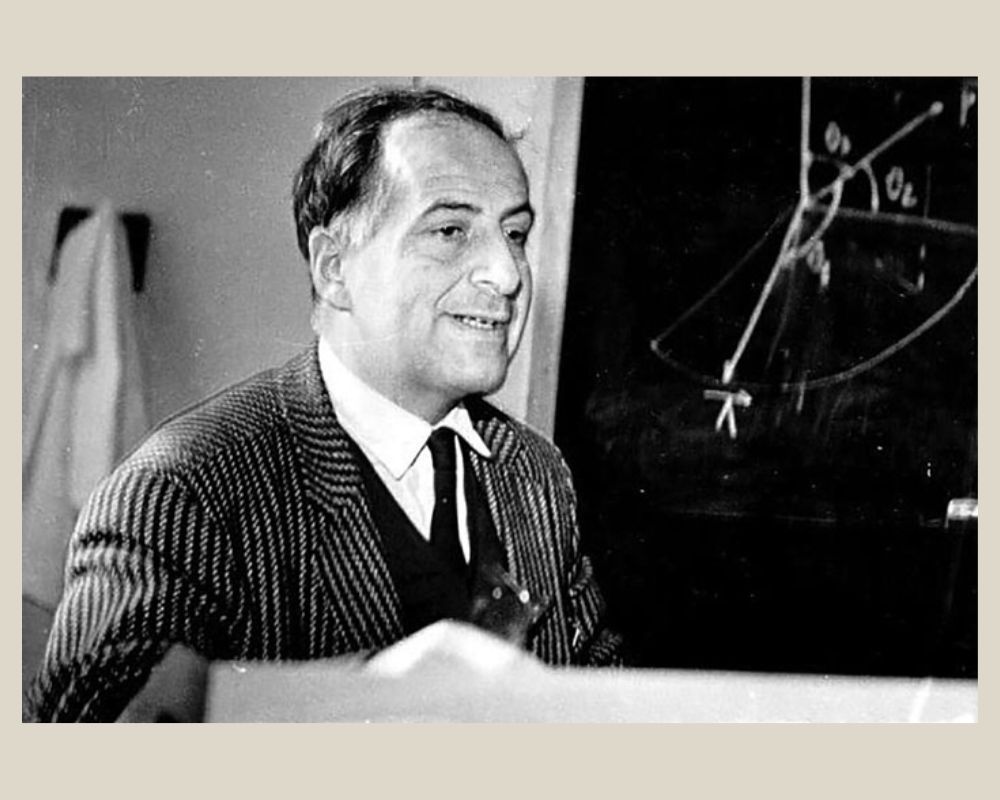
One issue of relevance when considering the early development of reactors by the Soviet Union is the extent to which it was aided by atomic espionage. The tale of Klaus Fuchs is familiar and he certainly helped Soviet bomb development, but I could find no solid evidence that he assisted with the development of the first “peaceful” Soviet reactor. I also took interest in the 1950 defection from Canada of Italian-born Bruno Pontecorvo. A masterful bio of Pontecorvo by Frank Close provides some elucidation but nothing definitive, and again, I was unable to conclude his defection boosted Soviet power reactor design efforts. Here is what Close writes about Pontecorvo’s friendship with Enrico Fermi (and even if Pontecorvo knew about Fermi’s work on the world’s first reactor, he certainly doesn’t seem to have been feeding any Soviet handler then and his defection was eight years in the future):
In April 1942 Bruno met with his mentor, Enrico Fermi, in hope of getting access to more supplies. Fermi had spent the winter shuttling back and forth between New York and Chicago, in preparation for his reactor experiment. He too was an “enemy alien” and had to get permission every time he made the trip. After April, Fermi moved to Chicago permanently but was still in New York when Bruno visited him. Bruno’s colleague from Paris, Hans von Halban, and Czech physicist George Placzek were also present.
Close, Frank. 2015. Half Life: The Divided Life of Bruno Pontecorvo, Physicist or Spy. OneWorld, London, pp. 82-83.
During the get-together, Bruno told the scientists about his work on neutron well-logging, including some of the technical details. Fermi was especially interested, making suggestions, showing deep knowledge of the subject, and asking questions. Bruno, who knew nothing of Fermi’s secret project, was surprised. He assumed that his work had no obvious relevance outside the field of oil prospecting, yet Fermi showed a keen thirst for information. Of course, Fermi’s interest stemmed from the reactor project. To build a successful reactor, Fermi would have to irradiate uranium with neutrons in the presence of graphite and other materials, so it was essential for him to understand as much as possible about how neutrons behave.
Bruno was unsuccessful in obtaining any essential materials from Fermi, but the meeting must have confirmed his suspicions that a major nuclear project was under way. Given Fermi’s questions, the presence of Halban (who had demonstrated fission alongside Bruno in 1939), and Bruno’s general knowledge of the state of nuclear physics before secrecy took over, it is inconceivable that he did not deduce what Fermi was up to. The details of the nuclear pile would have remained unknown to him, although it is clear that Fermi shared some of his own neutron data with Pontecorvo: in a report of this visit, written on April 15, Bruno commented that the data he had received from Fermi “had not been published, and cannot be published for a long time to come, because of their confidential character.”
Contrary to the spin propagated by the British government after Pontecorvo’s defection in 1950, it seems he was aware of at least some frontline data in 1942, several months before Fermi completed the first nuclear reactor. Moreover, Pontecorvo now knew that neutrons had become central to wartime nuclear research.