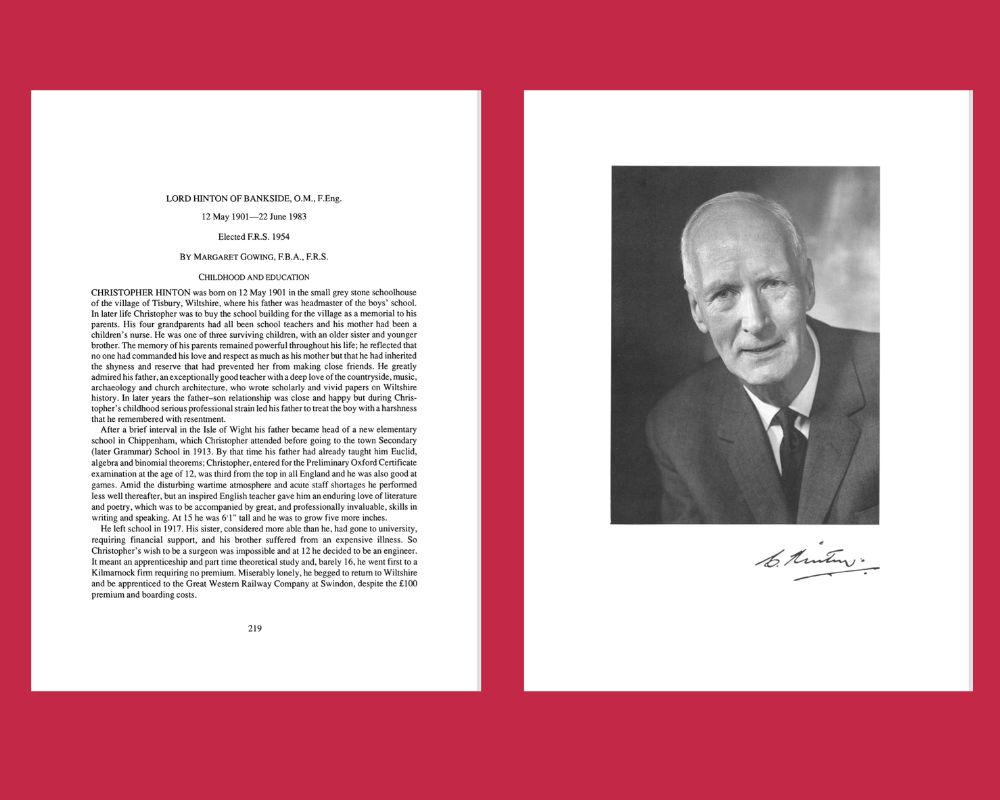
When the co-head of the postwar UK atomic effort, Christopher Hinton, died in 1983, aged 82, one of his eulogies came from an unusual source. Margaret Gowing, the official historian of the United Kingdom Atomic Energy Authority (with various names throughout its history), penned a remarkable 23-page eulogy. She was able to do this because she established a close professional relationship with Hinton, despite being twenty years younger. In my book I can barely do justice to the eulogy. For example, listen to her describe Hinton’s seminal wartime experience, running the “Explosive Filling Factories organization” from 1941, an experience that prepared him amply for his far more onerous and stressful nuclear decade:
It was huge, employing at peak 150,000 workers. There were eight new factories and two old ones, some employing 30,000 workers on three shifts. Nine smaller ones were also planned. His conclusion after a first factory tour and his introduction to the London headquarters, where he was to work, had been that he had never seen anything so “deplorably incompetent.”
Gowing describes how Hinton commandeered and reorganized nearly every department, with near miraculous effect:
The Director-General once told Hinton that the organization found him ‘too forceful’ in pressing his position if he felt he was right, but Hinton knew this was necessary to get anything done. Most of the executive management of the huge enterprise was gradually left to him. He wrote by hand detailed notes, charts and schedules showing the organization and staff of the Filling Factories and describing their functions and responsibilities. By 1943 they were able to deal extremely smoothly with rapidly changing demands, even when their Westminster headquarters were badly damaged by flying bombs.
Gowing, Margaret. 1990. “Lord Hinton of Bankside.” In Biographical Memoirs of Fellows of the Royal Society, Vol. 36, London, pp. 223-224.
Hinton deserves a full biography. And Gowing’s coverage of Hinton, not only in that eulogy but in her magisterial UKAEA histories (published in 1964 and 1974), suggests that she must have had priceless interview notes. Only recently did I realize that she donated her papers to the Museum of the History of Science. I wish I had examined them, although the museum’s terse overview suggests they have not been properly catalogued. A job for a future historian…