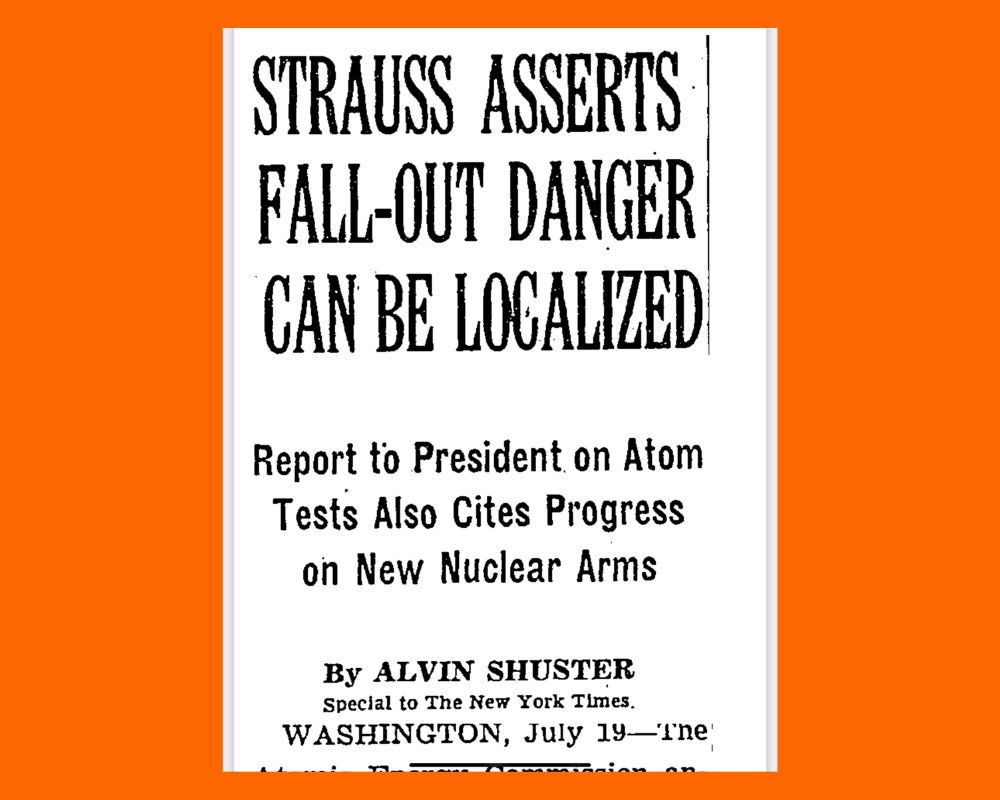
On July 19, 1956, the New York Times included an article that began: “The Atomic Energy Commission announced tonight that current atomic tests in the Pacific had proved it was now possible to minimize the ‘widespread fallout hazard’ from nuclear explosions. Lewis L. Strauss, commission chairman, made the announcement. He also said ‘real progress’ had been made in developing a variety of atomic weapons, including those for use against attacking aircraft.'”
In other words, Strauss, never one for subtlety, kicked off with a boast about bomb tests improving the effectiveness of the U.S. nuclear arsenal. This is hardly surprising since that was the entire point of testing. But then Strauss offered the following bromide that must have seen reporters’ jaws dropping. “Thus the current series of tests has produced much of importance not only from a military point of view but from a humanitarian aspect.” Paraphrasing: we’ve tested nuclear weapons to improve their wartime performance but our testing is a “humanitarian” act.
Strauss’s performance as AEC chairman is one of the reasons AEC gradually lost credibility after a rousing start.
Shuster, Alvin. 1956. “Strauss asserts fall-out danger can be localized.” New York Times, Jul. 20.